DALI-2, D4i or Zhaga-D4i? Four Questions to Ask Your LED Driver Supplier
DALI-2, D4i and Zhaga-D4i are not three generations of one protocol but one DALI line with its scope wrapped progressively wider. Using our real DALI models, this guide clarifies the difference and lists four hard questions to put to your driver supplier.
From a manufacturer's bench: the three are a progressively wider wrapper around one DALI line, not a replacement chain. DALI-2 is cross-vendor interoperability, D4i standardizes in-luminaire data, Zhaga-D4i is the pluggable port. Know which layer you need before specifying.
The short version
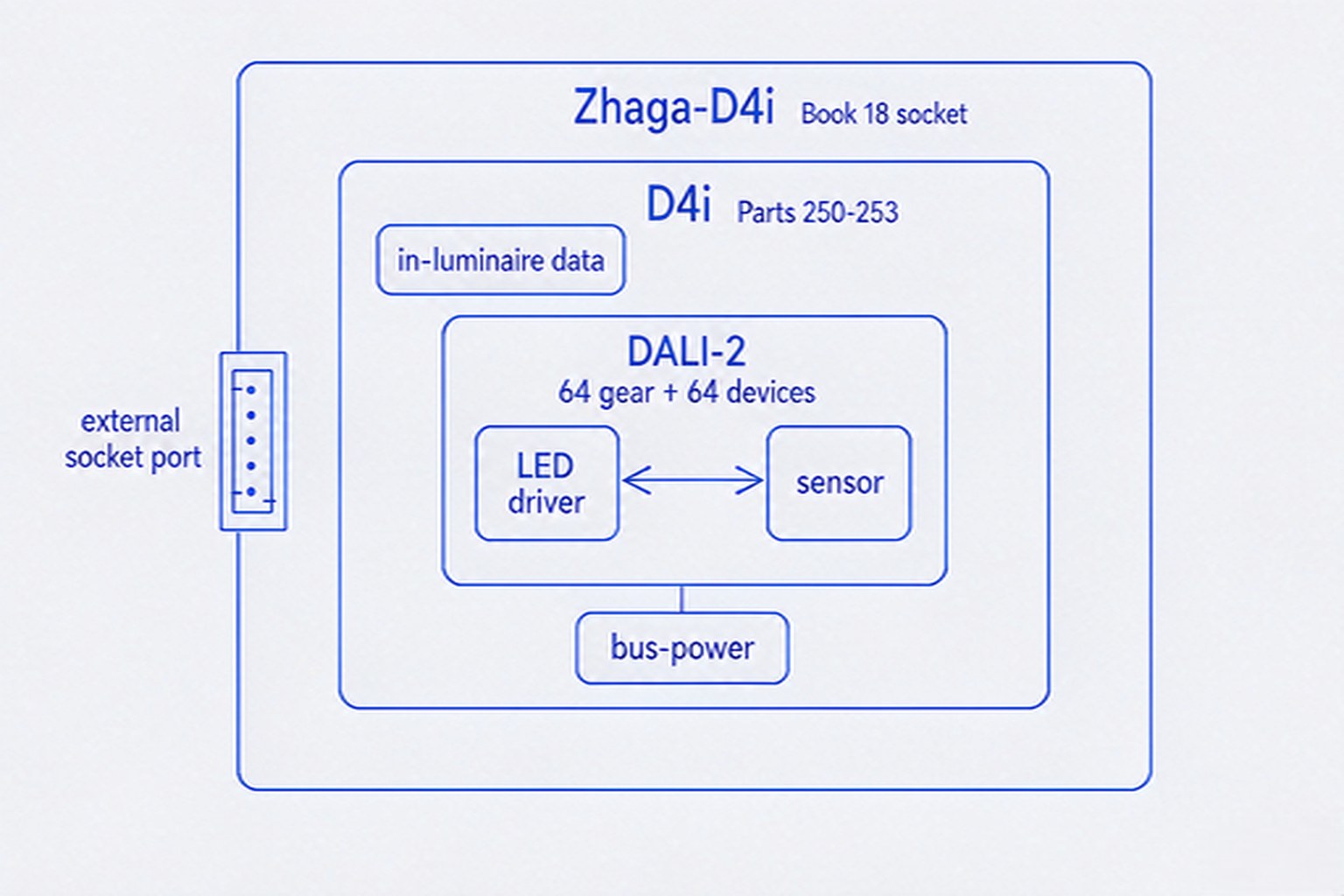
DALI-2, D4i and Zhaga-D4i are often described as three generations of a protocol. They are not. They are one DALI control line with the scope wrapped progressively wider. DALI-2 makes drivers and control devices from different vendors interoperate. D4i moves power and data inside the luminaire and standardizes them. Zhaga-D4i then puts a pluggable socket on the luminaire housing for sensors and comms nodes. Decide which layer you actually need before chasing the newest badge.
DALI-2: does your gear from different vendors talk?
DALI-2 is the generation where DiiA runs a real certification and database programme. It brings control devices — occupancy and light sensors, push-buttons, application controllers — into the certified ecosystem alongside control gear. A DALI-2 subnet holds up to 64 control gear (drivers, ballasts) in one address space and a separate 64 control devices, plus 16 groups and 16 scenes. DiiA's own cabling guidance is a 300 m maximum between any two devices on 1.5 mm² cable with a 250 mA bus supply budget — that is a point-to-point figure, not total cable length.
The practical meaning for buyers: if you only need addressable dimming, zoning and scenes driven by another brand's panel or controller, a DALI-2 dimmable driver is enough. Our K02 (DALI-2 DT6 constant-voltage 12/24 V, 60–400 W), K03 (DALI-2 DT8 tunable white), H08 (triple DALI + Push + 0–10 V, IP50) and H19 (constant-current DALI / 0–10V / Triac / rotary-code, 10–52 W for downlights) all sit at this layer.
D4i: power and data, inside the luminaire
D4i is not a new protocol — it is DALI-2 inside the luminaire. It makes four data parts mandatory for an LED driver: Part 250 integrated bus power supply, Part 251 luminaire data, Part 252 energy data, Part 253 diagnostics and maintenance (Part 150 auxiliary power is optional). In plain terms, a D4i driver stores and reports luminaire and driver energy, run-time and fault records in a standard format that a building management system can read on plug-in.
D4i also aligns with the North American ANSI C137.4-2019 and is compatible with NEMA/ANSI C136.41 and the Zhaga Book 18 socket. For smart-streetlight and connected-luminaire makers, this is the step from it dims to it is asset-manageable.
Zhaga-D4i: a pluggable port on the outside
Zhaga-D4i certifies the combination of Zhaga Book 18 (outdoor socket) and DiiA D4i: a standard socket on the luminaire where a sensor or comms node clicks on, plug-and-play. The luminaire ships without a specific sensor pre-installed; the node is added per project later.
What changed in 2026: Book 18 Edition 4 reaches heritage lighting
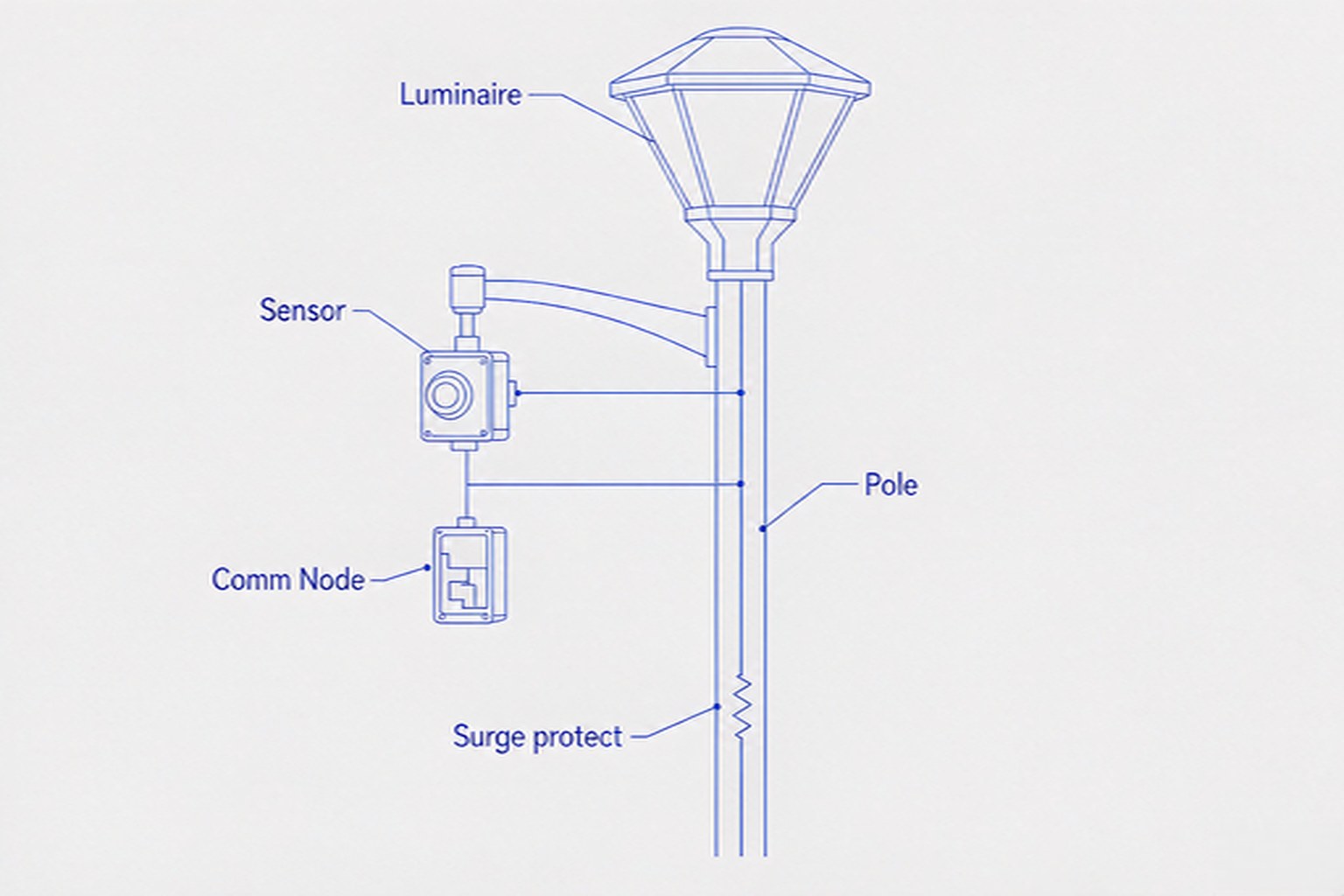
This year Zhaga released Book 18 Edition 4, extending the standard from ordinary streetlights to decorative and heritage outdoor luminaires. Those fixtures rarely allow a sensor mounted on the housing, so the spec introduced bracket-ready luminaires — the sensor or comms module sits on a pole bracket via a Zhaga socket, and the DALI bus runs through longer in-pole cabling. The standard therefore mandates surge protection on the communication link (DALI Part 151). For driver makers the implication is clear: the driver must carry its own protection for the D4i bus, not leave it to the luminaire factory to bolt on a separate device.
Back to selection: four questions for your supplier
- Do you need interoperability, or luminaire-level maintainability and connectivity? Zoned dimming across brands needs only DALI-2; per-luminaire energy reporting and remote diagnostics are where D4i enters.
- Does the driver actually carry D4i Parts 250–253? DALI dimming capability is not the same as D4i certification — ask the two separately and do not let "supports DALI" cover both.
- Is there a Zhaga Book 18 socket on the luminaire? Without that port, pluggable sensor cannot land.
- For outdoor or heritage projects, is surge protection on the D4i bus done? Check it against the Book 18 Edition 4 mandate.
What our line gives you
- For standard DALI-2 zoned dimming: K02, K03, H08, H19 cover constant-voltage and constant-current, single-colour to tunable white, indoor to IP50.
- For wireless connected luminaires: K05 (Mijia/Tuya Bluetooth·ZigBee, 24 V 200–400 W) works as an in-luminaire wireless node that bridges to a DALI+ network.
- Where strict D4i certification or a Zhaga-D4i socket is required, we confirm the specific model's certification status before quoting — we do not blend supports DALI dimming with D4i-certified.
Models mentioned in this article
- K02Half-Potted Constant Voltage Dimmable LED Driver60-400W · IP20
- K03CCT-Tunable Constant Voltage Dimmable LED Driver60-400W · IP20
- H083-in-1 Constant Voltage Dimmable LED Driver36-350W · IP50
- H19CCT-Tunable Constant Current LED Driver10-52W · IP20
- K05Smart Mi Home / Tuya CCT-Tunable Constant Voltage Dimmable LED Driver200-400W · IP20
Selection advice, quotes, samples and custom builds — call / WhatsApp +86 138 2356 2421 · Email [email protected]