DLC SSL V6.0: What the 15 December Delisting Means for Your LED Driver Data Package
On 15 December 2026 the DLC removes SSL V5.1 products that never transitioned to V6.0, and roughly 65% of North American commercial lighting rebates gate eligibility on that listing. Whether a fixture clears the raised thresholds depends largely on the LED driver inside it.
The QPL lists luminaires, not stand-alone drivers, so we cannot put our own name on it. What we can do is hand over four measured data sets before the filing window closes, so a luminaire carrying our driver clears V6.0 on the first submission.
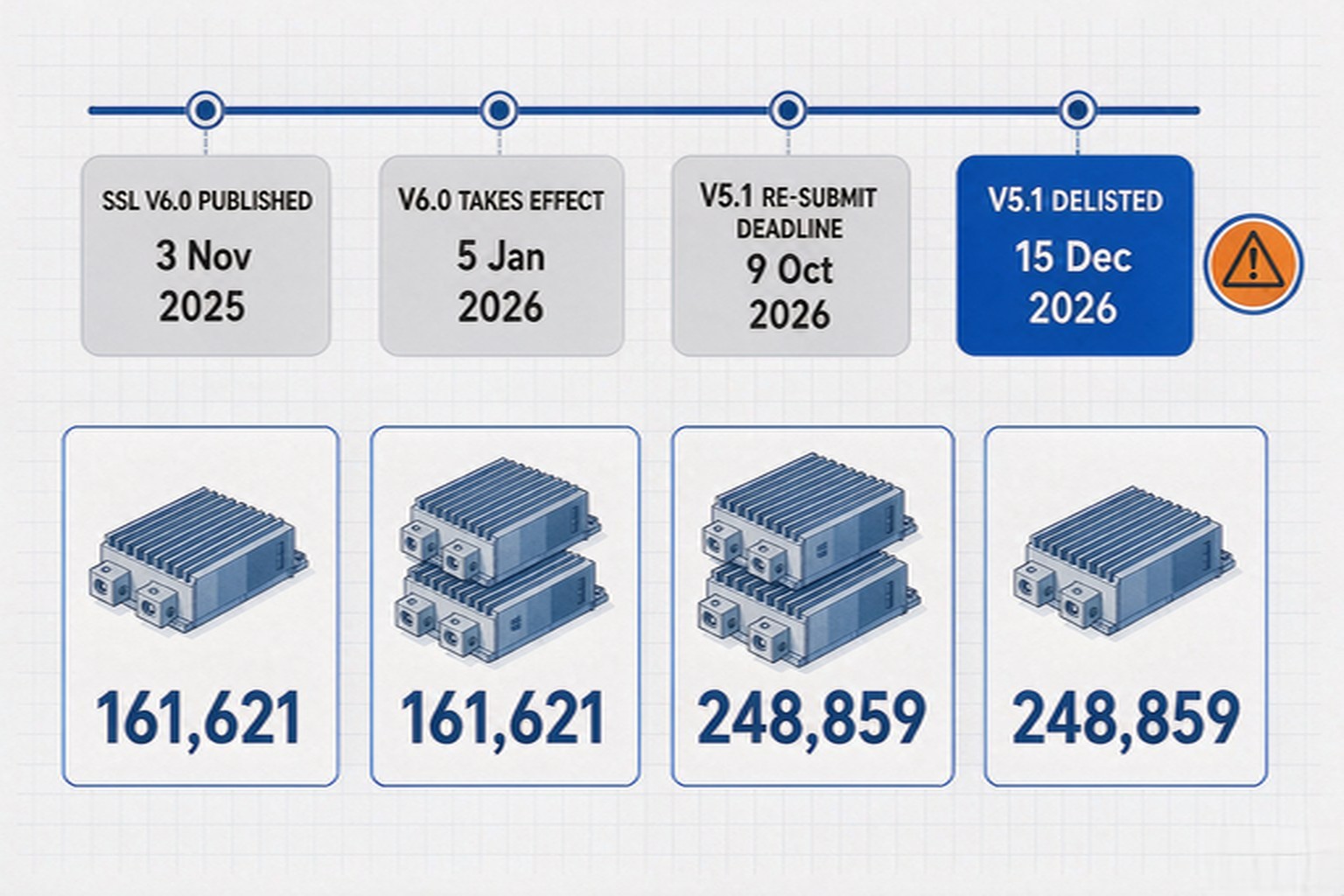
The four dates that matter
- 3 Nov 2025 — DLC publishes SSL V6.0, with LUNA V2.0 in the same release
- 5 Jan 2026 — V6.0 takes effect; the DLC begins accepting applications against it
- 9 Oct 2026 — deadline for products listed under V5.1 to be resubmitted; anything filed later counts as a new application
- 15 Dec 2026 — SSL V5.1 and LUNA V1.0 products that never completed the transition leave the Qualified Products List
That window is already closed.
How big this is
- As of 09:00 ET on 12 Oct 2026, 161,621 products were qualified under V6.0, while 248,859 remained listed under V5.1
- Roughly 65% of commercial lighting rebate offerings require DLC qualification, and close to 700 utility and efficiency programmes use the QPL as their eligibility gate
- Minimum efficacy rose by a weighted average of about 14% for Standard and 12% for Premium. Premium now weighs controllability — working with lighting controls and advanced systems — and asks for more detail on controls and adjustable features
- Programmes differ: Focus on Energy (Wisconsin) and ComEd (Illinois) require V6.0 from 1 Jan 2027; Avista allows 120 days of grace after delisting; FirstEnergy accepts the current or immediately preceding version
Put simply: the DLC decides what is listed, your local utility decides which version it accepts and when. Check both.
Our take: the pressure has reached the driver
The QPL lists luminaires, lamps and retrofit kits. A stand-alone LED driver is not listed in its own right, so we cannot claim a listing for ourselves. What we can do is make sure the luminaire carrying our driver clears V6.0 first time. That changes three things.
- The efficiency headroom is gone. With efficacy up 14%, a driver two or three points behind can push the fixture under the line. Designs that scraped through need re-checking.
- The dimming interface stops being optional. Premium scores controllability, so the choice between DALI-2, 0-10V and phase-cut belongs with whoever supplies the control system.
- Only measurable parameters count. A datasheet line saying "supports 0-10V" is not evidence; numbers are. It is also the first thing our North American customers now ask for.
Four data sets to request now
Enquiries reaching us from North America have changed: the opening question is no longer "do you have stock" but "can you send the data". Four sets.
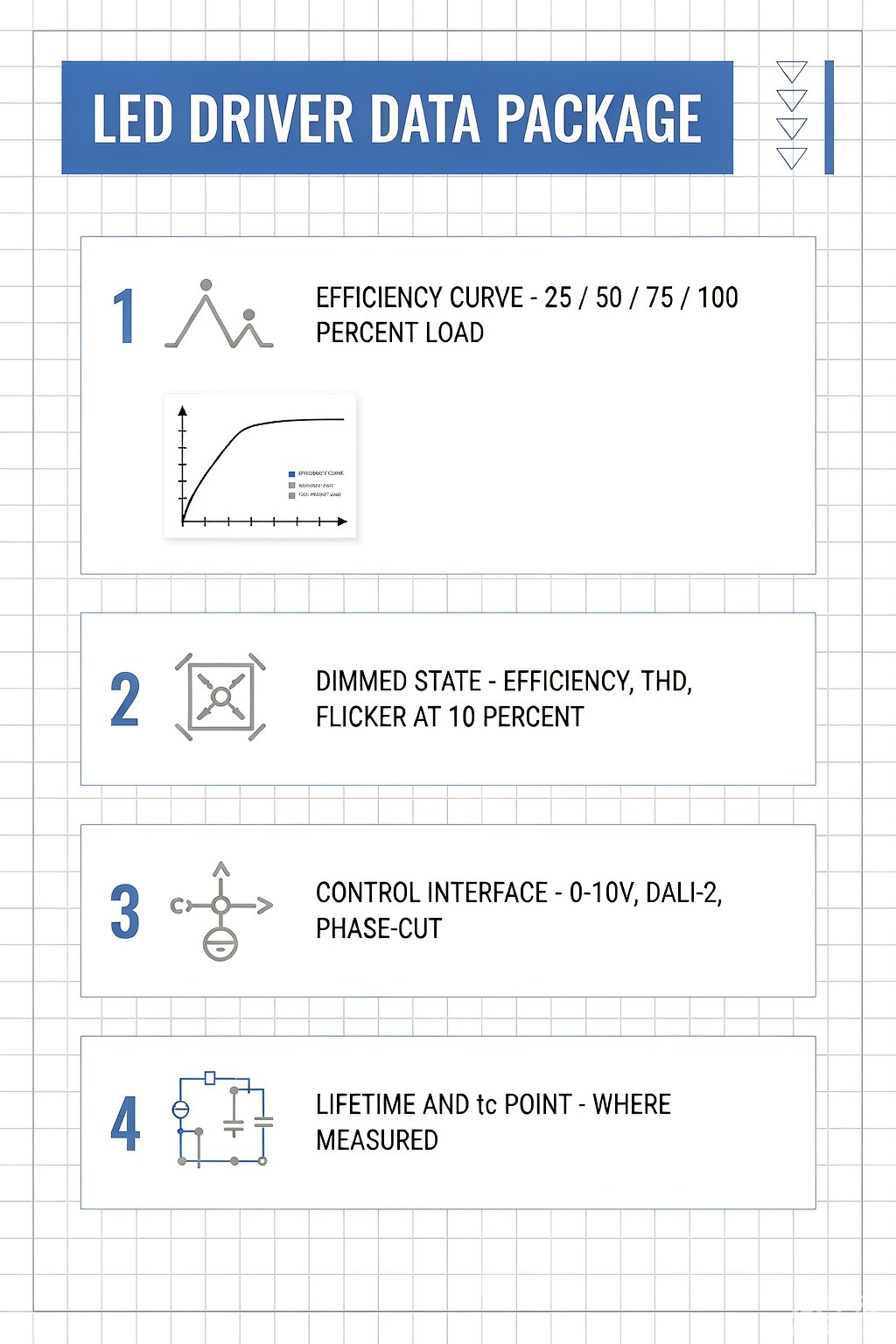
- Efficiency as a curve, not a point. Efficiency and power factor at 25%, 50%, 75% and 100% load. Most fixtures do not run at full output.
- Dimmed-state behaviour. Efficiency, THD and flicker at 10% output, plus no-load power after dim-to-off where the model supports it.
- Exactly what the interface can do. Sink and source current for 0-10V, short addresses and scenes actually supported on DALI-2, minimum load and a verified dimmer list for phase-cut.
- Lifetime with the tc point defined. Which tc the claimed life hours belong to, and where on the housing it is measured. A lifetime figure without a measurement point does not survive review.
Get all four and the filing clears without a second round. Miss one and it slips past 15 December, re-entering as a new submission.
Matching this to real models
- K02 — constant-voltage DALI-2 DT6, 12/24 V, 60–400 W. Confirm the command range actually supported and write the boundary into the technical file.
- K03 — DT8 tunable-white constant voltage, 12/24 V, 60–400 W, two- and three-wire compatible. Report efficacy at both colour-temperature extremes, not the midpoint.
- H08 — DALI + Push + 0-10V in one unit, 24 V, 36–350 W, IP50. One model, three control layers, one consistent set of paperwork.
- H19 — constant current, 10–52 W, 9–48 V, DALI / 0-10V / phase-cut / DIP-switch. The fastest route for small downlight trials where the interface may still change.
- K05 — 24 V, 200–400 W Bluetooth/ZigBee. Note for dual markets: networked standby is a separate item in the EU, where (EU) 2019/2020 caps no-load at 0.5 W for separate control gear.
- H13 — DIP-switch dimming, constant voltage, 24 V, 100–600 W. Convenient on site, but it counts as adjustable, so say precisely how the steps work.
What we would do this week
- Put "DLC listed, version X" against every SKU in the BOM and check each one on the QPL. A logo on a datasheet is not evidence.
- Cross-check the local rebate programme's effective date. The four above differ by months.
- Collect the four data sets now. Past the 9 October window a late submission re-enters the queue as a new application, with a different timeline and cost.
Models mentioned in this article
- K02Half-Potted Constant Voltage Dimmable LED Driver60-400W · IP20
- K03CCT-Tunable Constant Voltage Dimmable LED Driver60-400W · IP20
- H083-in-1 Constant Voltage Dimmable LED Driver36-350W · IP50
- H19CCT-Tunable Constant Current LED Driver10-52W · IP20
- K05Smart Mi Home / Tuya CCT-Tunable Constant Voltage Dimmable LED Driver200-400W · IP20
- H13Ultra-Slim DIP-Switching Constant Voltage Dimmable LED Driver100-600W · IP20
Selection advice, quotes, samples and custom builds — call / WhatsApp +86 138 2356 2421 · Email [email protected]