Brazil INMETRO 231/2026: The New Rules Land on the Driver, Not the Luminaire
Brazil's INMETRO Portaria nº 231/2026, notified to the WTO on 5 May 2026, adds tiered power factor limits, power tolerance, harmonics and mandatory Pst/SVM flicker testing. Here is why almost every one of those limits lands on the LED driver, and which six documents to demand from your driver supplier.
Five of the six new limits sit on the driver, so it has to ship as its own SKU with a traceable measured-data pack. CE, CB and ETL are not INMETRO.
What Actually Changed
On 5 May 2026 Brazil's INMETRO issued Portaria nº 231/2026, notified to the WTO as G/TBT/N/BRA/609/Add.6 and replacing Portaria nº 69 of 2022. The headline is that luminaires now fall inside mandatory certification; the detail that matters to us is quieter:
- Scope moved from integrated LED lamps to complete luminaires: fixed, recessed, floodlights and garden lights. Smart dimmable and CCT-tunable products are inside the list.
- Exemptions are explicit: public road lighting, LED strips, festive decorative lights, OLED, stage lighting and off-grid PV products. Classify your SKUs before spending money on testing.
- Separate control gear is assessed to NBR IEC 61347, while luminaire safety follows ABNT NBR IEC 60598-1.
In Brazil the LED driver is no longer "a part inside the luminaire". It has its own standard number.
Six Limits, Five of Them on the Driver
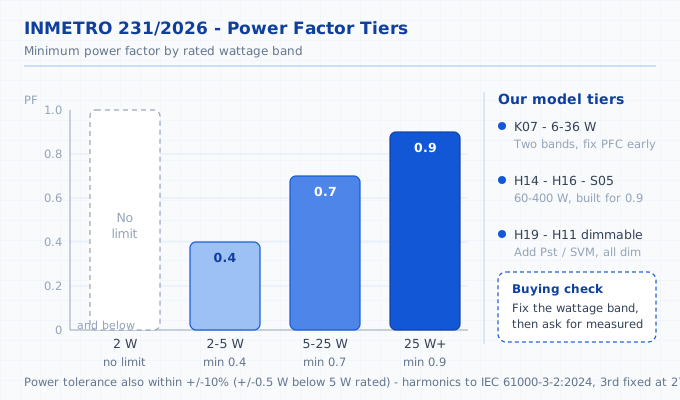
- Power factor, now tiered down to low wattages: no requirement at or below 2 W; minimum 0.4 for 2-5 W; 0.7 for 5-25 W; 0.9 above 25 W. The 2-5 W band had no limit at all before.
- Power tolerance: measured power within ±10% of rated, or ±0.5 W for products rated below 5 W.
- Harmonics: IEC 61000-3-2:2024, with the 3rd harmonic capped at a fixed 27% that is decoupled from power factor, and the 5th at 10%.
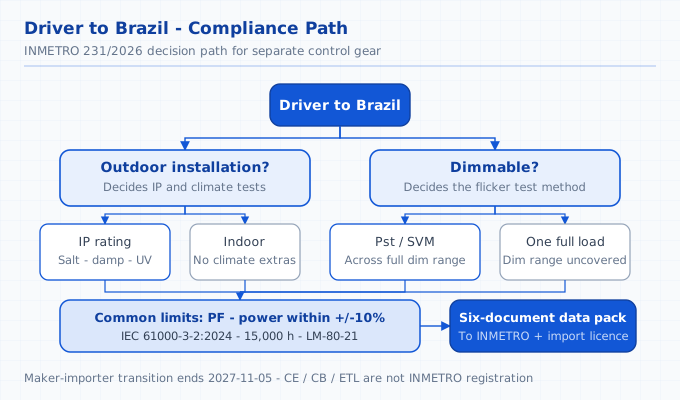
- Flicker, mandatory for the first time: two new tests, Pst (IEC TR 61547-1:2020) and SVM (IEC TR 63158:2018). For dimmable drivers the assessment runs across the full dimming range.
- Outdoor additions: IP rating, salt spray, damp-heat cycling and UV ageing, reproducing high-humidity and coastal-salt conditions.
- Durability: at least 15,000 h to 70% lumen maintenance, measured flux not below 90% of rated, backed by LM-80-21 data for the LED packages.
Five of those six are decided by the driver's input stage, its PFC topology and its output ripple. A luminaire maker with perfect thermal and optical design cannot recover a driver that measures 0.6 PF.
Dates: Do Not Plan Against 2030
- Manufacturers and importers: an 18-month transition ending 5 November 2027; six months after that, only compliant products may be sold.
- Distributors and retail: 48 months, to 5 May 2030, when Portaria 69/2022 is repealed.
Containers shipped after November 2027 should already be built to the new rule. Imports also run through a non-automatic import licence, and the date of shipment in the country of origin is what the deadline is counted from.
Our Take: Ship the Driver as Its Own SKU, with Its Own Data Pack
Looking across the 47 models we build, the same phrase - "200 W, 24 V, IP67 driver" - can hide two very different answers for measured PF, and for flicker at 10% dimming versus full output. Portaria 231 turns those values from marketing language into numbers somebody has to submit.
So we do not ship a certificate and call it done. Each model goes out with a data pack traceable to that model number:
- High power factor platforms - H14 (indoor, 60-400 W, 3C/LVD/EMC), H16 (IP67, LVD/EMC) and S05 (IP67, 200-400 W) are built around high-PF designs, covering the 0.7 and 0.9 tiers.
- Flicker under dimming - H19 (constant current, 10-52 W, DALI / 0-10 V / Triac / DIP-switch) and H11 (IP67, 30-300 W, DALI / 0-10 V / Triac, ETL listed) are specified as flicker-free. For these, Pst and SVM must be checked across the dimming range; a full-load-only reading tells you nothing.
- Salt spray and damp heat - IP67 models such as S04 (10-50 W), S06 (600-1000 W) and H16 use a potted construction, which survives salt spray and humidity cycling far better than a bare board.
- The low-wattage band - a 6-36 W part like K07 used to sit outside every PF limit. It now lands between the 2-5 W and 5-25 W tiers, so the PFC topology has to be settled at BOM stage.
One thing worth stating plainly: CE, CB and ETL are not INMETRO. The ETL listing on H11 is North American access, not Brazilian registration.
Six Things to Ask Your Driver Supplier
- Measured PF per model, stating the load point.
- A measured-versus-rated power table at minimum, typical and maximum load.
- An IEC 61000-3-2:2024 harmonic report with 3rd and 5th values.
- Pst and SVM reports - for dimmable models, across the full dimming range.
- For outdoor models: the IP report plus salt spray, damp-heat cycling and UV ageing.
- LM-80-21 data for the LED packages and the lumen-maintenance projection derived from it.
A supplier who cannot produce items 1, 3 and 4 usually has not measured them. That is a different problem from not being able to meet them.
Models mentioned in this article
- H14High-PF Constant Voltage LED Driver60-400W · IP20
- H16IP67 Waterproof High-PF Constant Voltage LED Driver60-400W · IP67
- S05IP67 Waterproof High-PF Wide-Input Constant Voltage LED Driver200-400W · IP67
- H19CCT-Tunable Constant Current LED Driver10-52W · IP20
- H11IP67 Waterproof Constant Voltage Dimmable LED Driver30-300W · IP67
- S04IP67 Waterproof Constant Voltage LED Driver10-50W · IP67
- S06IP67 Waterproof High Power Constant Voltage LED Driver600-1000W · IP67
- K07Detachable Housing Low Voltage Constant Voltage LED Driver6-36W · IP20
Selection advice, quotes, samples and custom builds — call / WhatsApp +86 138 2356 2421 · Email [email protected]