Why Outdoor LED Drivers Need Surge Protection: Built-in MOVs Will Not Survive a Lightning Strike
Most outdoor LED driver failures come from induced overvoltage and daily switching transients, not direct lightning. This guide explains the limits of built-in MOVs, the IEC 61643 Type 1/2/3 cascade, SPD-driver coordination, and a procurement checklist.
YFX IP67 potted drivers are the closest-to-load final clamp in the SPD cascade; they still need an upstream Type 2 SPD — the internal MOV is not lightning protection.
Lightning rarely strikes the luminaire directly
The failure that kills an outdoor LED driver is almost never a direct hit. A nearby strike — within a few hundred metres of a power line — induces and conducts a microsecond-scale overvoltage onto the distribution network, which travels straight to the driver inside the luminaire. On a standard low-voltage network these transients routinely exceed 6 kV, far above the withstand of the components inside a 300 W outdoor driver. More frequent than lightning are grid switching events: every time a contactor closes or a large load starts, the abrupt current change induces a 1–2 kV spike lasting tens of microseconds, several times a day on some networks.
Built-in protection is only the last line
The driver's input stage almost always carries a metal-oxide varistor (MOV) as a final clamp. IEC 61000-4-5 is the standard that rates a device's immunity: a typical outdoor driver is tested to "4 kV / 2 kA" (Level 4), with 1 kV line-to-line and 2 kV line-to-earth being common commercial values. The catch is that an MOV ages with every surge it absorbs — its clamping voltage drifts and leakage current rises — until one day, after a storm, it fails silently. Treating the driver's internal clamp as "lightning protection" means running your only protective part as a disposable component exposed to the full surge.
IEC 61643 defines the real defense
The actual defense is a cascaded surge protective device (SPD). IEC 61643-11 classifies SPDs into three types. Type 1 sits at the main service entrance and handles the 10/350 µs direct-strike current wave. Type 2 lives in the distribution board and absorbs the 8/20 µs induced and switching surges — this is the primary protection for most outdoor lighting. Type 3 provides residual protection close to the sensitive equipment. They must be coordinated: keep at least 5 m of cable (or a decoupling inductor) between Type 1 and Type 2, and 10 m before a Type 3, otherwise the stage closest to the load clamps first and absorbs energy it was never meant to carry.
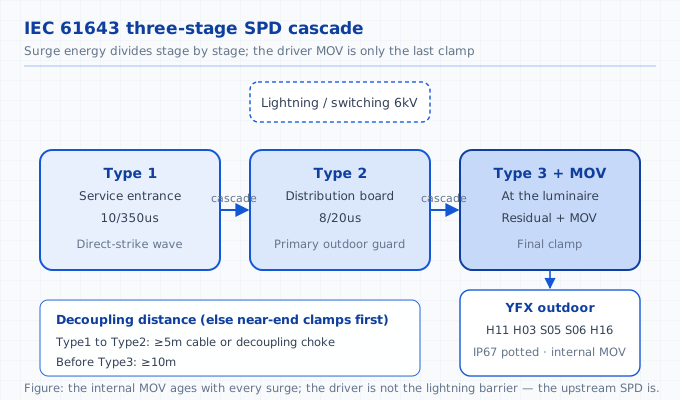
Coordination rule: the SPD's Up must sit below the driver's withstand
Selecting an SPD is not "bigger is better" — it is coordination. Its voltage protection level (Up) must be lower than the driver's IEC 61000-4-5 withstand, so the upstream SPD acts first and the driver only ever sees the margin it can handle. At the same time, size the rated discharge current to the site's lightning exposure: coastal sites, regions with more than 20 thunderstorm days per year, or overhead-fed poles need a much larger current rating.
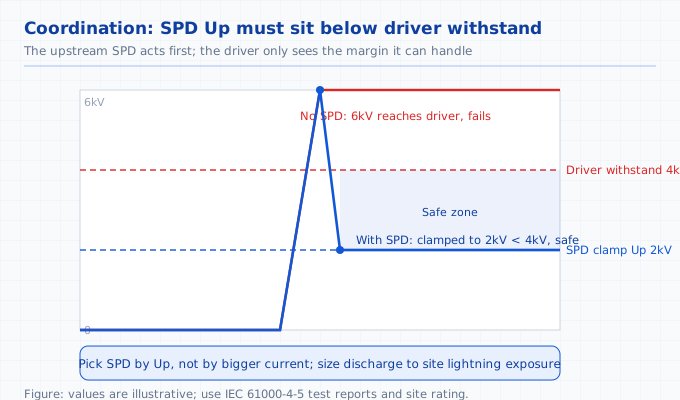
Earthing is the silent partner
An SPD can only divert current if there is a low-impedance path to earth. Poor earthing turns the SPD into decoration. In outdoor lighting, each pole or structure should have its own earth electrode where required, and the protective earth must be continuous, correctly sized, and bonded at the main panel. Surge damage often shows up weeks later, because the semiconductor fails progressively — a driver that dies "for no reason" should trigger a check of the surge protection before the replacement is specced to the same (insufficient) level.
Where YFX outdoor drivers fit
YFX IP67 potted waterproof drivers are exactly the closest-to-load final clamp in that SPD cascade. H11 (ETL-listed, IP67, 12 V / 24 V, 30–300 W, DALI / 0–10V / TRIAC) suits dimmable street and landscape lighting that also needs certification. H03 (IP67, 60–400 W, DALI / 0–10V tunable white) targets tunable-white scenes. S05 (IP67, 200–400 W, high power factor) and S06 (IP67, 24 V, 600–1000 W) cover mid-to-large area and signage lighting. H16 (IP67, LVD / EMC listed, 12 V / 24 V, 60–400 W) targets the EU market. All carry an internal MOV final clamp, but they still rely on an upstream Type 2 SPD to reserve the driver's internal protection for the small, frequent transients it was designed to absorb many times.
Procurement checklist
- Ask the manufacturer for the IEC 61000-4-5 test report, not just a "4 kV" line on the datasheet
- For street and sports lighting, specify at least 10 kV / 10 kA per ANSI C136.2; raise to 20 kV / 20 kA near coast or in high-lightning regions
- Specify SPDs certified to UL 1449 Type 4 or IEC 61643-11 Class II
- Require a failure indicator visible from ground level (LED or mechanical flag) for proactive maintenance
- Verify the SPD's voltage protection level (Up) is below the driver's withstand, with margin
Models mentioned in this article
- H11IP67 Waterproof Constant Voltage Dimmable LED Driver30-300W · IP67
- H03IP67 Waterproof CCT-Tunable Constant Voltage Dimmable LED Driver60-400W · IP67
- S05IP67 Waterproof High-PF Wide-Input Constant Voltage LED Driver200-400W · IP67
- S06IP67 Waterproof High Power Constant Voltage LED Driver600-1000W · IP67
- H16IP67 Waterproof High-PF Constant Voltage LED Driver60-400W · IP67
Selection advice, quotes, samples and custom builds — call / WhatsApp +86 138 2356 2421 · Email [email protected]