EU EPBD in Force: Networked Lighting Mandatory in New Commercial Buildings — D4i Gen 2 Drivers Become the Baseline
From May 2026 the revised EU EPBD forces networked lighting in new commercial buildings, making D4i Gen 2 drivers the baseline. This piece explains what it means for protocol choice, certification and sourcing, with YFX DALI models as the reference.
In the units sent back to us each year, genuine burnouts are rare — most failures are mismatched protocols or zero power headroom. EPBD just turned "can it connect" from a bonus into an entry ticket, so the first selection question shifts from "how much power" to "which system does it join."
From May 2026, the revised EU Energy Performance of Buildings Directive (EPBD) entered full implementation. For Chinese lighting exporters this is the most urgent compliance test of the year — it overturns the old logic that "a luminaire meeting the spec can enter the market on its own." The new rule requires every new EU commercial building to install automatic lighting controls and a building automation system. Smart lighting has moved from an optional add-on to a hard requirement for new commercial projects.
What does this mean for the LED driver? The product is no longer a standalone item; it must be "network-capable and integrable," able to plug into the building management system for occupancy- and daylight-based dimming and energy monitoring. The driver side is now expected to meet D4i Gen 2 requirements: not just DALI dimming, but energy metering and fault diagnostics under DALI Part 250–253, with the driver mounted independently on pluggable terminals and not sharing a heat path with the LED module.
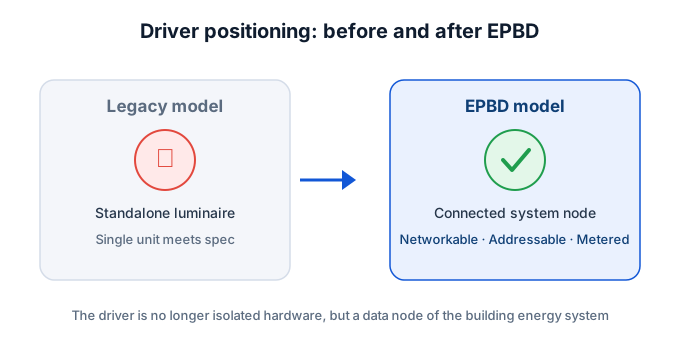
For buyers, the most visible change is the protocol threshold. "Whether to dim" used to be a nice-to-have; now "can it connect, can it be addressed by the system" is the entry ticket. Our H01, H02 and H03 belong to the DALI-2 / D4i family, supporting individual addressing and scene grouping — exactly what the new rule calls for. New-build hotels, exhibition halls and premium commercial spaces now essentially spec to D4i by default.
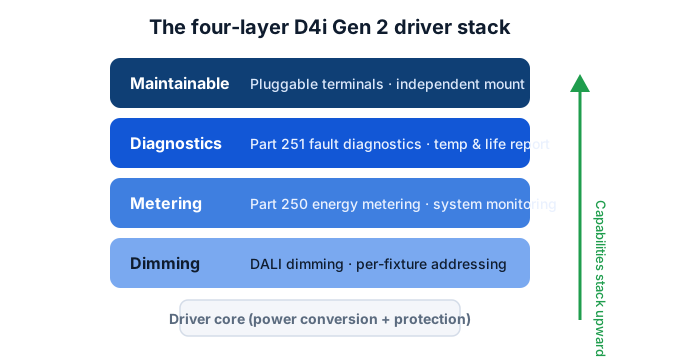
The D4i diagnostics layer is where the real payoff sits. Part 251 lets the driver report its own health — temperature, runtime, end-of-life warnings — back to the building system, so facility managers can replace a unit before it fails rather than after. For a hotel or retail chain running hundreds of fixtures, that telemetry turns lighting maintenance from reactive to predictive, and it feeds precisely the energy-monitoring goal the EPBD is built around.
Do not overlook the energy floor. EU Ecodesign Regulation (EU) 2019/2020 caps the no-load and off-mode standby power of separate control gear — external LED drivers — at 0.5 W. That means when the light is off but the driver is still mains-connected, the parasitic draw from the auxiliary rail and any radio must be pushed to near zero. Every YFX driver with networking or dimming is designed to ≤0.5 W standby.
For specifiers, the practical checklist is short but non-negotiable: confirm the destination market first (EU vs North America vs elsewhere), then verify the driver carries the matching certification (CE/ENEC for the EU, UL plus DLC for the US), and only then choose wattage and form factor. A DALI-2 driver perfect for a Berlin office is the wrong answer for a Chicago warehouse, and vice versa. Our dimming comparison tool and the power factor guide walk through the trade-offs.
Cross-market note: North America runs on a different rulebook. DLC SSL V6.0 began accepting applications on 5 January 2026 and, on 1 October 2026, removed non-certified V5.1 products from its QPL list. The new standard demands a 50,000-hour driver life and continuous dimming to ≤20% (≤10% for Premium). Exporters to the US must also watch DOE's Level VII efficiency draft, which would cut no-load power by a further 25%.
One-line takeaway: after 2026, a driver's core competitiveness shifts from "lumen efficacy numbers" to "data-interface parameters." Before you buy, confirm which market your project serves and which system it connects to — then lock the protocol and model. That is far cheaper than a post-install swap.
If you have a fixture list or site photos, call / WhatsApp +86 138 2356 2421 — we will match model, wattage and protocol for every channel in one pass.
Models mentioned in this article
Selection advice, quotes, samples and custom builds — call / WhatsApp +86 138 2356 2421 · Email [email protected]